Any price
Sandy Bay Estate Riesling
A delightfully zesty expression of Cool climate Riesling, sourced from some of the oldest Riesling vineyards in Tasmania. Perfumed with Spring blossoms, citrus and crisp red apple. Dry in style with a clean line of acidity and lime-like freshness.
Sandy Bay Estate Tasmania Riesling
Save 20%91 points$27.00$21.60 eachin any 6Bargain

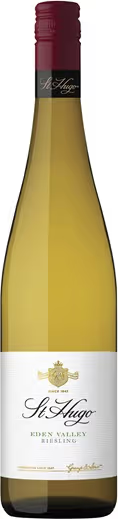
St Hugo Riesling
An outstanding modern Australian Riesling with great cellaring potential. Careful winemaking allows the premium fruit from the pristine Eden Valley to take centre stage. The vibrant nose offers fragrant fresh lemon/lime blossom, with notes of bath salts.The refined palate is delicate and pure, showing a slaty minerality and a taut line of acidity.Ideal Drinking Window 2017 to 2032
St Hugo Riesling
Save 22%97 points$40.50$31.50 eachin any 6Bargain
Lark Hill Regional Riesling
Lark Hill Regional Riesling
Save 18%$25.20$20.70 eachin any 6BargainLark Hill Regional Riesling 2025
$28.00 eachin cases of 6 for $168Price consistently high


Mystery Margaret River Riesling Deal No. 6109
Josef Chromy Riesling
Josef Chromy is the ultimate example of the fact that its never too late to fulfil your dreams, having launched his wine label at the age of 76. Hes had great success since, as youll discover with this Riesling. In the glass: Bright pale lemon. On the nose: Tightly wound and delicate. On the palate: Pristine, dry and crisp with a lemon and lime fruit core. Really refined and precise, it has a wonderful quinine-like texture and very tight acidity that will ensure success in the cellar.
Josef Chromy Riesling 2023
$25.00 eachin cases of 6 for $150Price consistently lowJosef Chromy Riesling NV
Save 14%$35.00$30.00 eachTypical price


Minchinbury Riesling
This Riesling, sourced from premium Australian vineyards, exhibits aromatic notes of zesty lemon citrus and florals with a lively refreshing acidity on the clean, dry finish.
Minchinbury Riesling
Save 14%$6.99$6.00 eachBargain

Giesen Riesling
Famous for their popular and flavoursome Sauvignon Blanc, Giesen produce an enticing and pure Riesling from the same region, Marlborough. Displaying notes of citrus, white flowers and ginger on the nose, this attractive off-dry Riesling shows subtle sweet flavours of lemon curd, mandarin and orange peel. Those flavours are then balanced beautifully with a structured acid backbone and minerality that keeps the succulent flavours dancing on the palate for an age.
Giesen Riesling
Save 12%$15.99$14.00 eachBargainGiesen Riesling 2021
Save 20%$20.00$16.00 eachHigh price


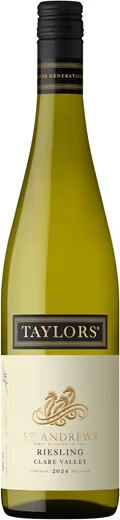
Taylors St Andrews Riesling
The St Andrews range from Taylors fly the flag for the iconic South Australian winery. The ultra premium wines are the true expression of the winemaking talents and terroir in which the fruit in grown. The Riesling has taken a little time to develop, but is now showing brilliant lime, citrus and tropical fruit balanced with cutting acidity.
Taylors St Andrews Riesling
Save 20%93 points$41.40$33.30 eachin any 6BargainTaylors St Andrews Riesling 2024
$39.90$41.80 eachin any 6Price rise
Mockingbird Hill Clare Valley Riesling
Riesling is the most important grape for the Clare region and the Clare examples are some of the best the country produces. This is a beautiful example displaying excellent fruit definition with the typical lime, citrus peel and talc notes and is another classic in the making.
Mockingbird Hill Clare Valley Riesling 2025
Save 20%$14.99$12.00 eachBargain

Chaffey Bros Not Your Grandma's Riesling
Not Your Grandmas Riesling has just a hint of residual sweetness which works just perfectly here. Fresh and floral, there's ample citrus and orchid fruits with perfectly balanced acidity for line and length. It works perfectly with or without food. Born and raised in the Barossa, Daniel started at the Penfolds cellar door, eventually co-founding a wine consultancy. Chaffey Bros. was born from Daniels dream to revive the name and the innovation of his great-great grandfather and his brother the original Chaffey brothers who founded Mildura in 1887. Together with his brother-in-law Theo Engela they now form the new iteration of Chaffey Bros. They love telling stories, and each of their wine labels reveals details about the vineyard, variety, region or history.
Chaffey Bros Not Your Grandma's Riesling
Save 20%97 points$22.50$18.00 eachin any 6BargainChaffey Bros Not Your Grandma's Riesling 2026
$26.00 eachin cases of 6 for $156Price consistently high

